In-House vs. Engineering Recruitment Agency: Which Is Better for Your Infrastructure Project?

It’s May 2026, and if you’re standing on a major infrastructure site in the UK right now, you can almost hear the sound of money evaporating. It’s not the cost of plant hire or the price of steel: though those aren't exactly cheap. It’s the sound of silence from the roles you haven't filled yet.
The UK is currently sitting on a £718bn infrastructure pipeline. From massive data centre clusters in the M4 corridor to the ongoing evolution of the rail network and the 'Electrification Surge,' the demand for talent has never been higher. But here is the kicker: we are officially in the era of the 'Great Labour Drain.'
While the government is busy announcing new tenders, the boots on the ground are getting harder to find. If you’re a project manager or a director, you’re likely facing a classic dilemma: Do you let your internal HR team hunt for talent, or do you call in a specialist engineering recruitment agency?
Let’s be straight-talking about this. Both have their place, but in the high-stakes world of infrastructure, choosing the wrong one won’t just cost you a fee: it’ll cost you the project timeline.
The £718bn Pipeline vs. The Great Labour Drain
The scale of work scheduled for the next decade is staggering. However, the pool of genuinely skilled tradespeople isn’t growing at the same rate. We aren't just talking about 'labourers'; we are talking about high-level M&E professionals, BIM coordinators, and HV technicians.
The 'Great Labour Drain' isn't a myth. It’s the result of a retiring workforce meeting a massive spike in technical requirements. When every major contractor in the country is fishing in the same small pond, your in-house team is going up against specialists who have been baiting that pond for nearly two decades.
The In-House Slog: Why 'Traditional' Hiring is Stalling
Most in-house HR departments are excellent at what they do: hiring for the core business. They understand company culture, they know the benefits package inside out, and they are great at finding a new Marketing Manager or a junior administrator.
But infrastructure recruitment is a different beast entirely. Here is why the in-house route often becomes a slow-motion car crash for engineering projects:
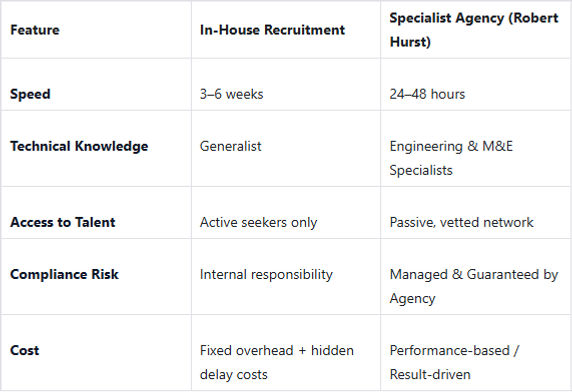
- The Speed Deficit: An internal recruiter usually posts an ad on LinkedIn or a generic job board and waits. In 2026, the best skilled tradespeople don’t look at job boards. They are already working. While your HR team waits for applications to trickle in, your site schedule is slipping.
- The Knowledge Gap: Does your internal recruiter know the difference between a standard sparky and someone qualified for high-spec data centre fit-outs? Do they understand the nuances of mechanical industry requirements in 2026? Usually, the answer is no. This leads to 'CV dumping': sending you ten candidates in the hope that one might actually be able to do the job.
- The Hidden Overhead: People think in-house is 'free' because they already pay the HR salary. But calculate the cost of a site manager spending five hours a week interviewing the wrong people. Calculate the cost of a project delay penalty. Suddenly, 'free' looks incredibly expensive.
The Agency Advantage: Speed, Niche, and the 'Capability Gap'
When you partner with a specialist engineering recruitment agency like Robert Hurst Group, you aren't just paying for a CV. You’re paying for a pre-built network.
At Robert Hurst, we’ve spent over 17 years building a database that doesn't just list names: it lists reputations. We know who shows up, who knows their way around a complex BIM model, and who can lead a team under pressure.
Bridging the 'Capability Gap'
In 2026, the requirements for infrastructure projects have evolved. It’s no longer just about 'bodies.' It’s about specialised skills:
- BIM & Digital QA: If your labour doesn't understand digital reporting, your compliance is dead in the water.
- High-Level M&E: The complexity of modern HVAC and electrical systems requires more than just basic qualifications.
- Niche Certifications: Finding someone with the exact ticket for a specific site requirement shouldn't take you three weeks.
24 to 48 Hour Turnaround
In the world of skilled trade recruitment, speed is the only currency that matters. If a sub-contractor lets you down on a Friday, you need a replacement by Monday morning. An in-house team simply cannot move that fast. At Robert Hurst, our average placement speed for critical roles is 24-48 hours. We don’t start the search when you call; we’ve been searching for 17 years.
The Compliance Headache: Your Secret Risk
Let’s talk about the part of the job everyone hates: the paperwork. Compliance in 2026 is a minefield. CSCS cards, CIS status, Right-to-Work documentation, and specific health and safety certifications are non-negotiable.
If an in-house team misses one document, and there’s a site audit or: heaven forbid: an accident, the liability falls squarely on your shoulders.
When you work with a specialist agency, we take that entire burden off your desk. We handle:
- Verification of all CSCS/JIB/SkillCards.
- Rigorous Right-to-Work and identity checks.
- CIS and payroll compliance.
- Reference checking that actually goes beyond a 'tick-box' exercise.
We make sure that when a worker walks onto your site, they are fully vetted, fully compliant, and ready to go. You can submit a job today and stop worrying about whether your site manager is spending his afternoon chasing copies of passports.
The Comparison:
When Should You Use Which?
We aren't going to tell you that an agency is the answer for every single hire. If you need a permanent office receptionist or a junior accounts assistant, keep it in-house. You have the time, the risk is low, and the talent pool is wide.
However, if you are looking for:
- Mechanical Estimators to price a high-stakes tender.
- HVAC Technicians for a critical data centre project.
- Pipefitters or Electricians for a major infrastructure overhaul.
- Site Supervisors who actually understand the current UK construction labour costs.
...then an in-house search is a gamble you probably shouldn't take.
The Robert Hurst Group Difference
We’ve been in this game since 2004. We’ve seen the industry through recessions, booms, and the current 2026 infrastructure explosion. Our approach is simple: we are straight-talking, we move fast, and we actually know what a good engineer looks like.
We don't just 'fill roles.' We safeguard your project timelines. By handling the heavy lifting of recruitment: the sourcing, the vetting, and the compliance: we allow your site managers to do what they are actually paid for: managing the site.
The £718bn pipeline is waiting. Don't let your project be the one that stalls because you were waiting on a CV from a job board.
Ready to see how fast we can move? Register with us or get in touch with our team today, and let’s get the right boots on your site before the week is out.
Comments are disabled